

Conventional wisdom says consumers don't trust AI customer service, but recent data tells a different story.
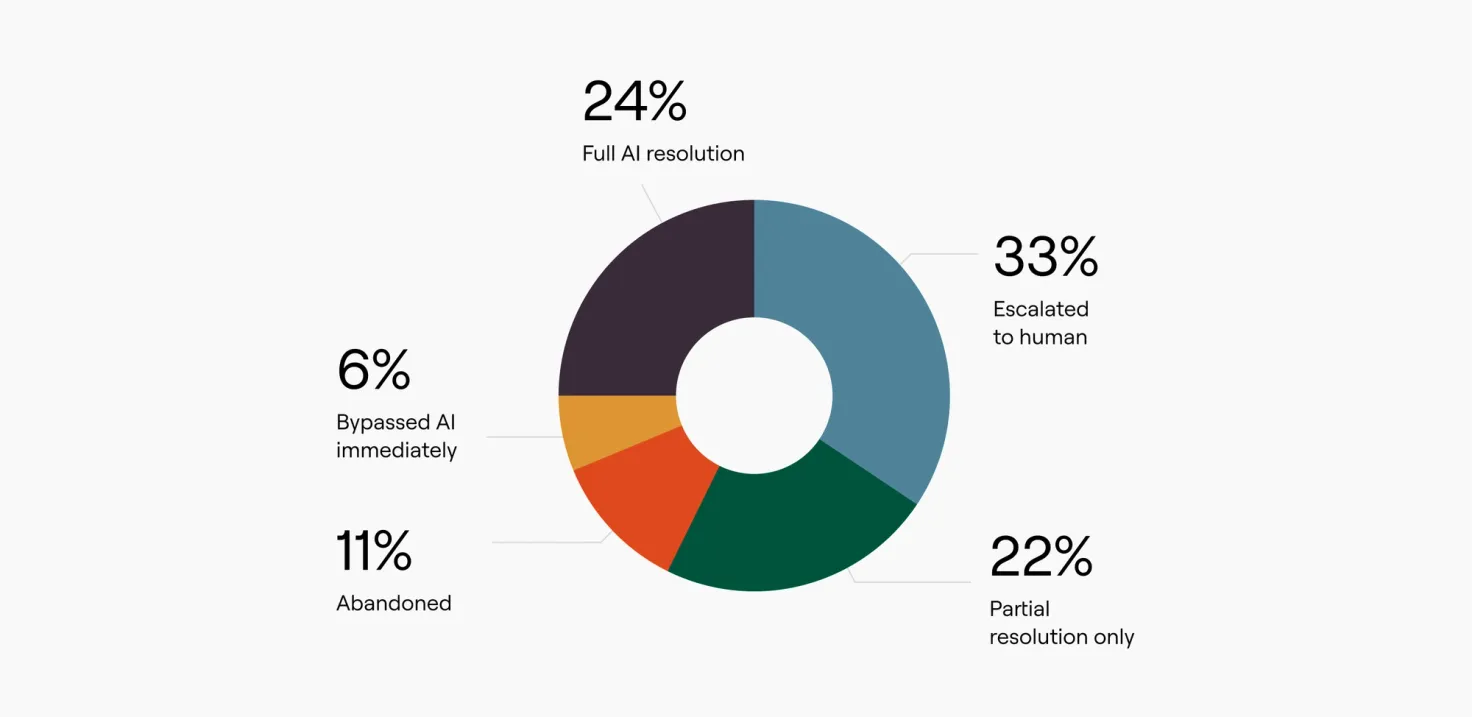
According to Ada's 2026 Agentic CX Report, 59% of consumers actually prefer always-on, 24/7 AI over waiting for a human. Yet only 24% of consumers report having their issue fully resolved by AI without human involvement.
The remaining 76% escalate to a human, abandon the interaction, or walk away with only a partial resolution. Only 32% of consumers rate their most recent AI customer service experience an 8 or higher out of 10.
The gap between what consumers want from AI and what they’re actually getting reveals something important: trust is determined by whether the AI is capable enough to earn it. That's why the trust story looks very different from one industry to the next.
A food delivery refund, a service outage, and an insurance claim may all begin as customer service interactions, but they carry very different stakes and expectations. The more useful question is where AI has already earned consumer trust, where expectations are becoming more demanding, and what separates organizations that are successfully expanding AI from those still struggling to move beyond basic automation.
The stakes determine the standard
Consumers aren't skeptical of AI. They're skeptical of AI that fails them, and their tolerance for failure scales directly with what's at stake.
When asked to choose between a faster, solution-focused AI and a more empathetic AI in a billing error scenario, the result wasn't close.
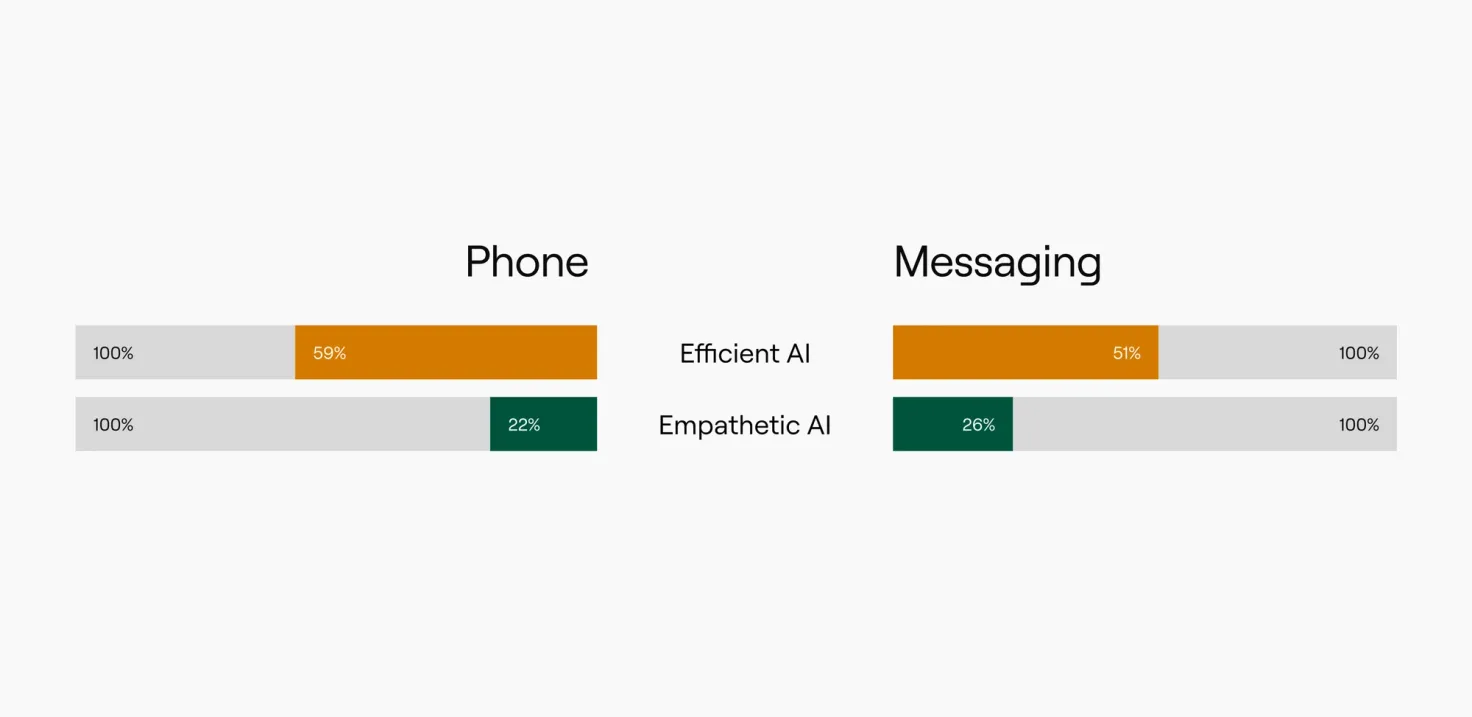
In voice interactions, 59% chose the faster AI compared to 22% for the empathetic version. In messaging, the split was 51% versus 26%.
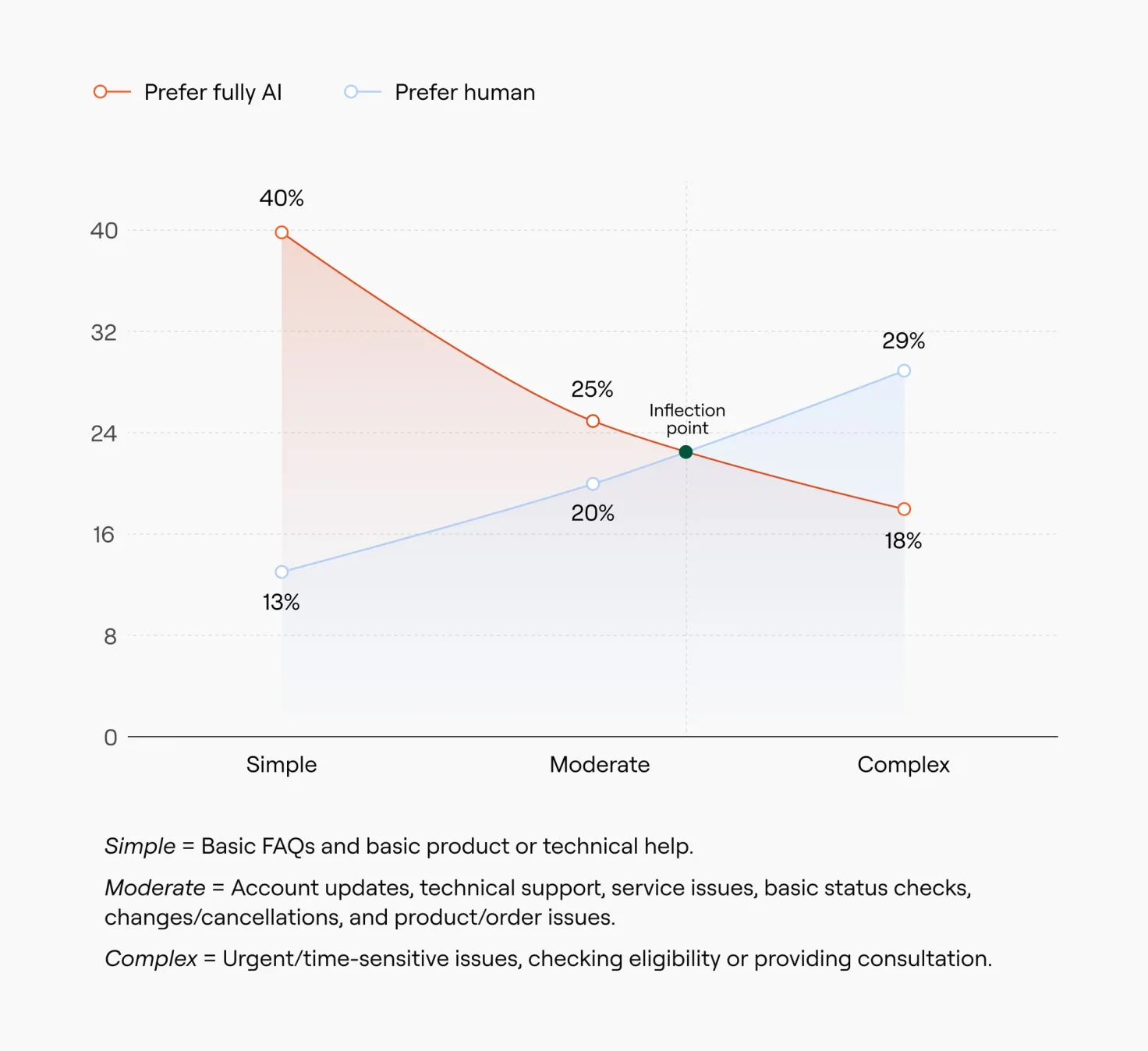
But resolution isn't equally forgiving across every context. As complexity increases, so does the standard consumers hold AI to:
- 40% prefer fully AI for simple tasks like FAQs and basic product questions.
- 25% prefer fully AI for moderate tasks like account updates, cancellations, and billing issues.
- 18% prefer fully AI for complex tasks like eligibility checks, consultations, and urgent issues.
That's not a rejection of AI. It's a calibrated response to risk.
The industries earning the most consumer trust aren't necessarily the ones with the most advanced AI. They're often the ones where the path to resolution is clearest and the cost of a mistake is lowest.
As the stakes rise, trust becomes harder to earn and capability becomes harder to fake. For most organizations, the question isn't whether consumers will accept AI for complex issues—18% already prefer it. It's whether their AI has been built to handle them.
Entertainment, technology, and retail: Where AI has already earned trust
The instinctive explanation for why some industries outperform others is technology. It's tempting to assume retail has better AI than healthcare, or that entertainment companies have somehow solved a problem that financial institutions haven't.
The data suggests something different. Consumers don't grant trust based on the sophistication of the AI. They grant it based on the consequences of failure.
When a gaming subscription charge is wrong or a food delivery refund takes the wrong path, the outcome is usually recoverable. That creates room for AI to prove itself, and when it does, trust compounds. Consumers stop evaluating whether they want AI involved and start evaluating whether the issue was solved.
Entertainment and gaming, technology and software, and retail are the clearest examples of three industries where AI preference either leads or nearly matches human preference.
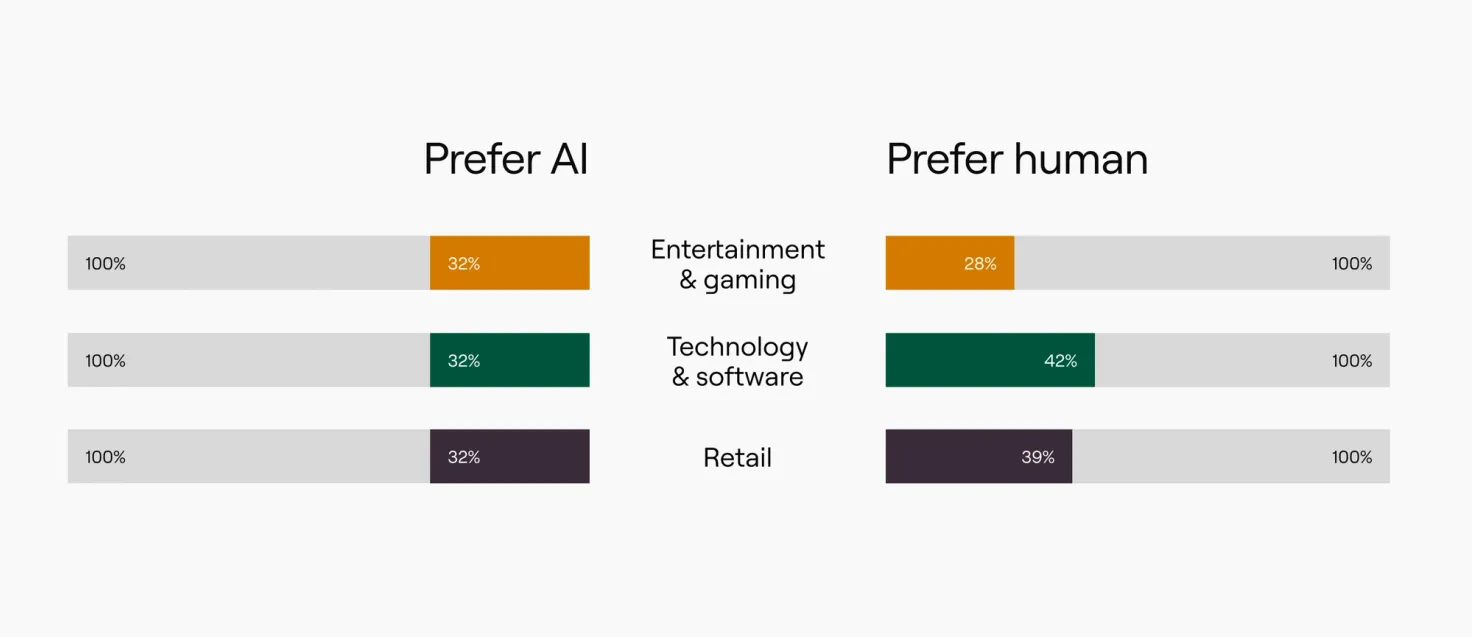
Across all three, AI preference is identical at 32%. What differs is the gap.
Entertainment and gaming is the only vertical where AI has crossed into positive territory. Consumers have had enough successful experiences that they've stopped evaluating the channel and started evaluating the outcome.
The significance isn't consumer enthusiasm, it's accumulated experience. The conversation in these sectors has already moved beyond adoption and toward expansion, extending agentic customer experience into increasingly complex customer journeys while maintaining the reliability that earned consumer trust in the first place.

Travel and beyond: Where expectations have outpaced delivery
If trust compounds through successful outcomes, telecom, travel, and food delivery show what happens when AI performance is still catching up to consumer expectation.
Consumers in these industries arrive with well-formed expectations for digital self-service. They know what good looks like, which means they notice when AI falls short. A service outage, a cancelled flight, or a billing dispute carries urgency that a subscription inquiry doesn't. The expectation isn't simply that AI responds. It's that the interaction moves the problem toward resolution.
That gap between expectation and delivery shows up clearly in the preference data.
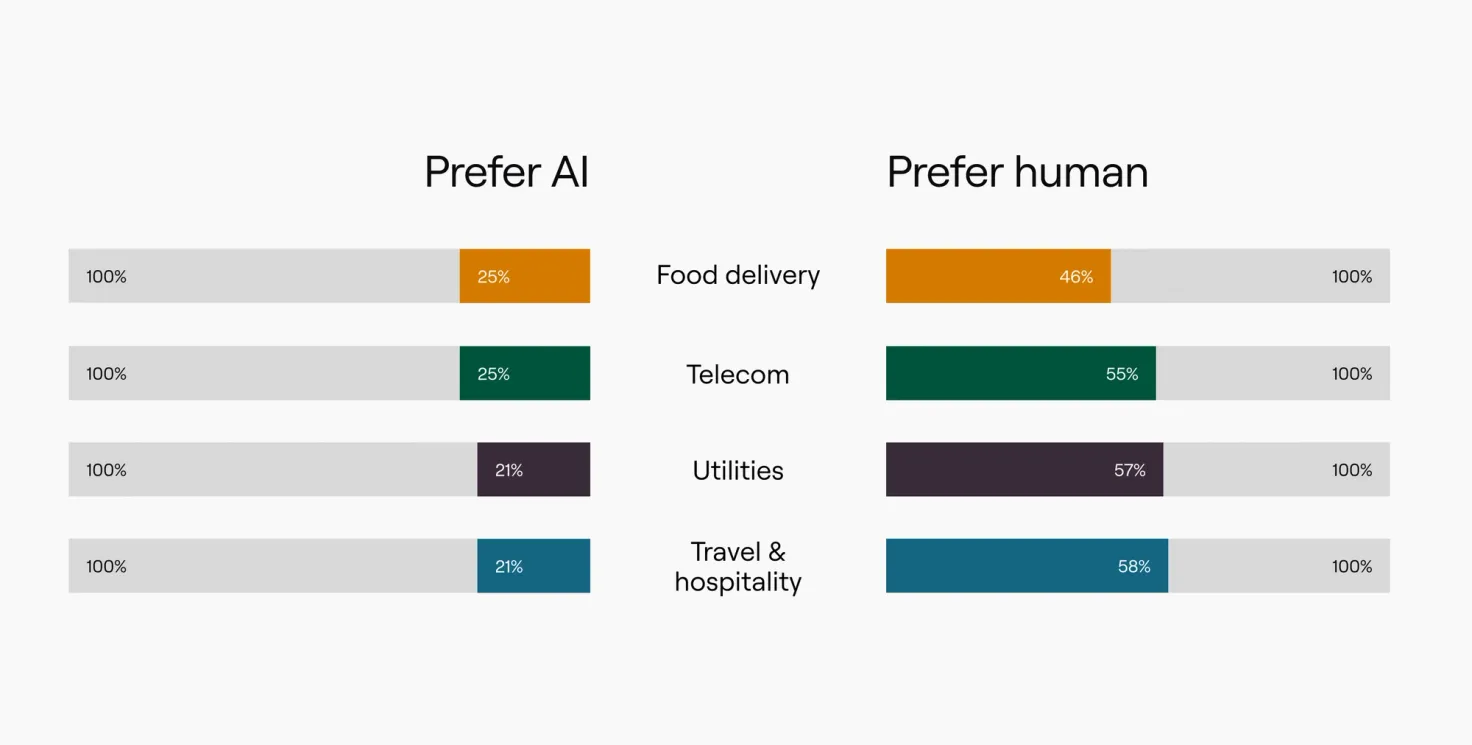
Human preference leads by a significant margin across all four. But these aren't industries where consumers have given up on AI. They're industries where the bar has risen faster than capability has kept pace, and where the design of the experience matters as much as the capability behind it.
That's why escalation is the critical variable in AI customer service for telecom and travel. In Ada's research, 57% of consumers say they would stop using a company's AI service if they couldn't transfer to a human when needed.
When AI becomes a barrier to resolution instead of a path toward it, trust erodes quickly. In industries where consumers interact with their providers regularly, erosion compounds.
The organizations succeeding here are designing agentic customer experiences that resolve what AI can handle quickly and accurately, then hand off everything else without friction.

Financial services and insurance: Where trust must be earned
The bar is higher for conversational AI in banking and insurance—not because consumers trust AI less, but because the consequences of failure are greater.
An incorrect financial transaction, a mishandled insurance claim, or inaccurate healthcare information can have lasting consequences that a delayed refund simply cannot. That reality shows up in the preference data. No other industry cluster comes close to these gaps.
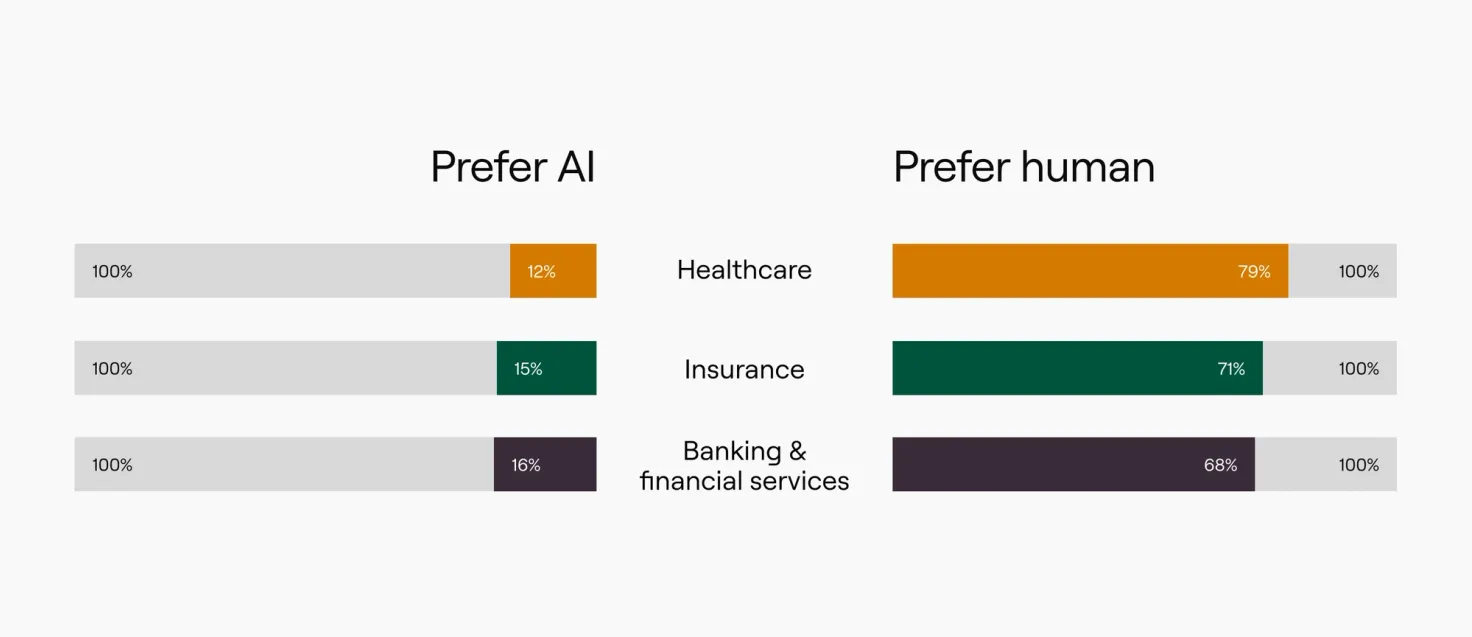
More than two in three banking and financial services consumers actively prefer a human. Insurance isn't far behind. These are the industries sitting at the bottom of the AI preference spectrum, and the reason isn't skepticism. It's consequence.
Consumers in regulated industries are signaling what they need before they'll trust AI with higher-stakes decisions: accuracy, transparency, security, and a clear path to human judgment when the situation requires it.
For AI to work in these environments, capability alone isn't enough. It needs guardrails, grounding in verified sources, and escalation paths that are unconditional. That's why many of the design choices that feel optional in lower-stakes industries become essential here.
For health insurers and financial services organizations, that means AI that can accurately handle claims questions, eligibility checks, and policy interpretation—built on governance controls that ensure responses are always compliant, secure, and explainable, with a human always reachable.
Organizations wondering how to make AI customer service HIPAA compliant should start there: governance built before deployment, not after an incident. In practice, that means role-based access controls, zero-retention data agreements with AI providers, and policy and benefits content reviewed and approved before it enters the knowledge base.

Across every industry, consumers want the same thing
Across all ten industries, every demographic cohort, and all 2,000 consumers surveyed, the same pattern emerged: consumers reward outcomes. They're asking businesses to make AI more capable.
When asked to distribute 100 points across the customer service features that mattered most to them, the results cut against some of the most persistent assumptions in the industry:
- Problem-solving ability and accuracy both scored 18
- Human escalation option scored 16
- Data privacy/security scored 15
- Speed of resolution scored 14
- 24/7 availability scored 12
- Transparency about being AI, personalization, and anticipating needs all scored 7
- Empathy scored 6
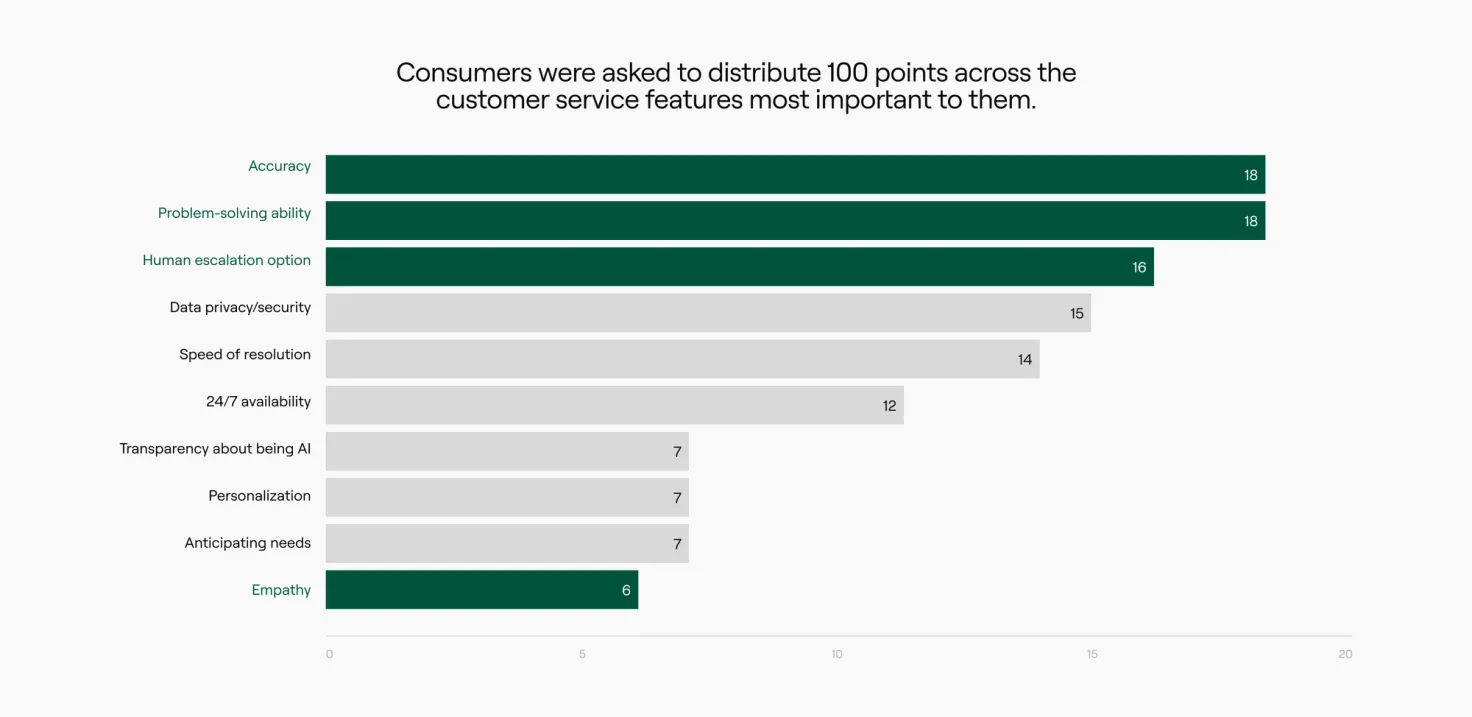
Consumers aren't asking businesses to make AI feel more human. They're asking businesses to make AI more capable. The biggest trust risks reinforce the same point.
When consumers were asked what would make them stop using a company's AI service, the top answer wasn't lack of empathy, it was being unable to reach a human when needed, cited by 57%. A related gap: 74% of consumers expect to know they're talking to AI before or at the very start of an interaction. Neither of these is a technology problem. They're decisions.
Taken together, the message is consistent across every industry: consumers want AI that understands the issue, provides an accurate answer, takes the right action, and connects them to a human when necessary. Everything else is secondary.

What comes next
The challenge for most organizations isn't understanding what consumers want. The data is remarkably clear: consumers want AI that solves problems accurately, takes action when appropriate, protects their information, and makes it easy to reach a human when needed.
The challenge is delivering that experience consistently.
The gap between consumer expectations and current performance shows up in one number: automated resolution rate. This is the share of interactions fully resolved by AI without human involvement. Unlike containment or deflection, it measures whether the customer's issue was actually solved.
At 24%, it tells you exactly where the industry stands.
Closing that gap requires more than deploying an AI agent. It requires building the capability to continuously improve one.
The organizations making the most progress share a few things in common:
- They measure AI performance separately from human performance: 55% of businesses still blend the two, which makes it structurally impossible to know where AI is falling short.
- They've built governance before scaling, not in response to an incident, and they've designed escalation as a feature, not a fallback.
That's the operational difference between basic automation and agentic customer experience.
Different industries face different challenges, but the underlying mandate is the same. Trust isn't created through a single interaction. It's earned through thousands of interactions that consistently deliver the outcome consumers expect.
That's how trust is earned. And increasingly, that's how competitive advantage is built.
Agentic CX in 2026: What consumers expect and most enterprises miss
There’s a common assumption that consumers are skeptical of AI in customer service. The data says otherwise. Our 2026 report surveyed 2,000 consumers to understand how people actually experience AI in customer service today.
Read report